

Recyclable materials: types, processing and use in manufacturing
Methods of processing plastics into products
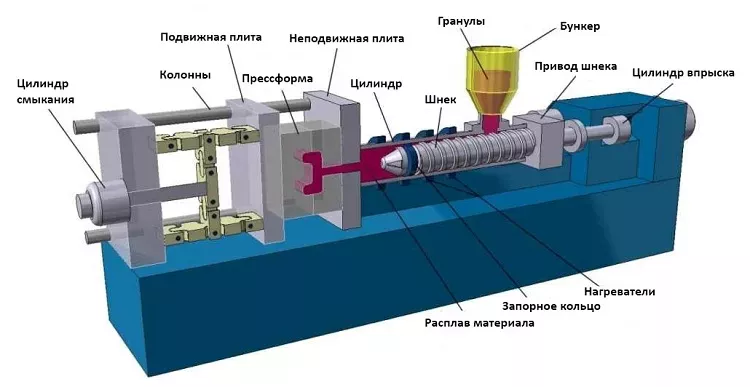
The main advantages of injection moulding are high part repeatability, a fast production cycle, the ability to produce complex geometries, and a reduction in unit cost as production volumes increase. At the same time, the technology requires an initial investment in the mould, so it is most suitable for repetitive mass production.
The main advantages of die-casting
Injection moulding enables the production of large batches of products with consistent characteristics, but each advantage is only realised under certain conditions. Key factors include the design of the part, the mould design, the properties of the polymer, the stability of pressure and temperature conditions, and process control at all stages of production.
| Advantage | What does this mean for the customer? | Under what conditions is it implemented? |
| Repeatability | The components of the various batches have consistent dimensions | Consistent material, shape and process parameters |
| High performance | The ability to produce large batches | A well-established production cycle and the corresponding mould |
| Lower production costs across the range | Set-up costs are allocated across the print run | A sufficient level of production |
| Complex geometry | A single component can incorporate several functional elements | The design complies with DFM requirements |
| Choice of materials | The properties of the component can be adapted to the conditions of use | The polymer is compatible with the design and technology |
| Surface quality | It is possible to reduce the amount of additional processing | Properly designed mould shape and casting processes |
| Automation | Fewer manual operations and more consistent production | Availability of the appropriate equipment and tools |
What determines the economic viability of die-casting?
The key economic feature of the technology is the initial costs of designing and manufacturing the mould, with the proportion of these costs in the unit price gradually decreasing as the total production run increases.
It is therefore not just the cost of the tooling or the first batch that needs to be assessed. The entire product life cycle must be taken into account: design development, mould commissioning, test samples, production runs, repeat orders, maintenance and any potential product modifications.
Why is there no single minimum print run?
There is no universal minimum number of parts required to start production. The economics are different for a small, simple product than for a large, technical part with complex mould mechanisms. Even the same production run may be viable for one product but unprofitable for another.
The decision is influenced by:
- the complexity of the geometry and surface requirements;
- the number of cavities in the mould;
- the material of the tooling and its expected service life;
- the weight of a single item and the polymer consumption;
- the duration of filling, compression and cooling;
- the need for metal inserts;
- assembly, labelling and other processing operations;
- the volume of the first consignment;
- forecast of repeat orders;
- the acceptable cost price of the finished product.
The first batch should not be assessed in isolation from the overall production plan. It may be relatively small, but if the products are required on a regular basis over a long period, the cost of the mould is spread across the total volume, rather than just the first order.
For a product with unproven demand, it makes more sense to first evaluate the design using 3D printing or another prototyping method. Once testing has been carried out, any errors have been rectified and the design has been finalised, it is possible to move on to the manufacture of production tooling.
What determines the unit cost of a part in a production run?
The cost price is not determined by a single factor. It comprises:
- proportion of the mould cost;
- polymer raw materials;
- machine time;
- energy;
- work;
- quality control;
- packaging;
- maintenance of tooling;
- post-moulding operations.
The more finished parts that can be produced using a single set of tooling, the smaller the proportion of initial costs in the unit price becomes. However, a larger production run does not automatically mean the lowest possible price. If a product is heavy, has a long production cycle, involves complex mechanisms or requires manual assembly, these costs are factored into the production cost of each part.
The calculation is also influenced by the defect rate, production downtime, the consistency of raw materials and design considerations. For example, reducing cycle time must not compromise mould filling or result in insufficient cooling. Cost savings must be assessed alongside quality requirements.
To carry out a preliminary calculation, the manufacturer needs:
- A 3D model or drawing;
- intended use of the product;
- material requirements;
- expected print run;
- frequency of repeat batches;
- tolerances;
- colour and texture;
- List of post-casting operations.
Without this data, it is only possible to determine the general suitability of the technology, but not the accurate cost of the finished part.
Disadvantages and limitations of die-casting
Pressure moulding is not suitable for every project. The main limitation is the need to first create a precise and manufacturable mould. The design, manufacture, testing and adjustment of the mould require time and resources. Therefore, this method is rarely the best option for a single item or a design that changes regularly.
Another limitation relates to the geometry of the component. To ensure stable filling and uniform cooling, it is necessary to control wall thickness, transitions between sections, radii, slopes and undercuts. A part with very thin walls may require higher pressure and a material with appropriate fluidity. Excessively thick sections take longer to cool, creating a risk of sink marks, internal voids or deformation.
It is not always possible to alter the geometry once the tooling has been manufactured. Minor adjustments are sometimes made by machining the insert. However, repositioning a hole, adding material or making a significant change to the configuration may require a new insert or an entirely new mould. This is precisely why checking the 3D model before starting work on the metal has a direct impact on lead times, budget and risks.
It is also necessary to take the behaviour of the polymer into account. Different materials have different shrinkage rates, flow properties, processing temperatures and drying requirements. Replacing raw materials without carrying out tests does not guarantee that the finished product will retain its original dimensions, strength and appearance.
Therefore, this technology is worth considering if:
- the design of the product has already been finalised;
- repeatable production runs are required;
- it is important that the geometry is consistent;
- a budget has been set aside for equipment;
- there is a forecast demand;
- There are plans to scale up production.
Another method may be more appropriate if only one prototype is required, the product is still undergoing frequent changes, or the future production run is unknown.
Frequently Asked Questions
From what production run does injection moulding become cost-effective?
There is no single minimum production run. Economic viability depends on the cost of the mould, the complexity of the part, the material, the cycle time and the number of repeat runs.
Is this technology suitable for small batches?
For example, if a mould already exists, repeat orders are expected, or specific properties of the production material are required. For a small number of prototypes with variable designs, 3D printing or machining is often the more appropriate option.
What determines the accuracy of plastic components?
Accuracy depends on the product’s design, the properties and shrinkage of the material, the quality of the mould, the cooling process and the stability of the injection moulding parameters. Precise tolerances are determined individually for each specific part and polymer.