
The advantages of plastic injection moulding for mass production
Plastic products are manufactured using several main methods: injection moulding, extrusion, thermoforming, blow moulding, rotational moulding and 3D printing. The choice of technology depends on the shape and dimensions of the part, the type of polymer, the required precision, the production run and the acceptable unit cost of the product. For example, injection moulding is ideal for the mass production of parts with complex geometries, whilst extrusion is mainly used for the continuous production of profiles, pipes, sheets and films.
The main methods of manufacturing plastic products
During the processing of plastics, the material is shaped as required under the influence of temperature, pressure, vacuum or rotation. Each of these methods has its own area of application: one technology is better suited to precision parts, whilst another is better suited to hollow products, packaging or the continuous production of profiles.
| Method | For which products | Optimal scale | The main feature |
| Die-casting | Housings, technical parts, fasteners, complex-shaped components | Medium and large production runs | High accuracy and repeatability |
| Extrusion | Profiles, pipes, films, sheets | Large volumes | Continuous production |
| Thermoforming | Packaging, trays, casings | Medium and large production runs | Forming the heated sheet |
| Blow Molding | Bottles, jerry cans, containers | Large series | Manufacture of hollow products |
| Rotational Molding | Tanks, reservoirs, large hollow components | Small and medium-sized series | Suitable for large items |
| 3D printing | Prototypes, experimental parts and one-off components | Single items and small batches | Does not require a traditional mould |
The manufacturing method for products should be determined as early as the design stage. A design that is well suited to casting will not necessarily be suitable for thermoforming or extrusion.
How does the type of polymer affect the manufacturing process?
Thermoplastics can be heated to a plastic or molten state, moulded, cooled and, if necessary, reheated. Common thermoplastic polymers include polyethylene, PVC, polypropylene, polystyrene and polyamides. It is thermoplastics that are most commonly processed by injection moulding, extrusion, thermoforming and blow moulding.
When a thermoplastic is heated, the polymer enters a state in which it can be moved and moulded. Once cooled, the product retains its specified shape. The temperature regime depends on the specific polymer and the technical requirements for the finished products.
Moulding in a heated mould may be used to manufacture products from thermosetting plastics. Powder or pre-formed pellets are placed in the mould, after which the material fills the mould cavity under the action of temperature and pressure and cures. This principle is used, in particular, during the compression moulding of certain phenolic and amino resins. Once cured, these polymers no longer return to a plastic state when heated.
Plastic injection moulding
Injection moulding is used to manufacture complex-shaped plastic products where dimensional accuracy, part consistency and the ability to produce in batches are important. The method is suitable for housings, fasteners, technical components, parts for domestic appliances, electronics and other products of various shapes and sizes.
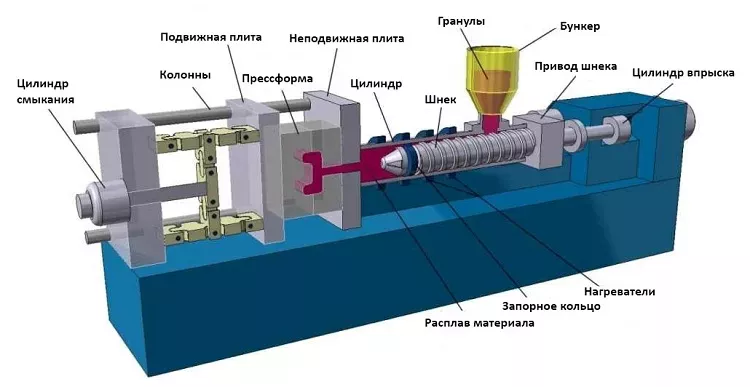
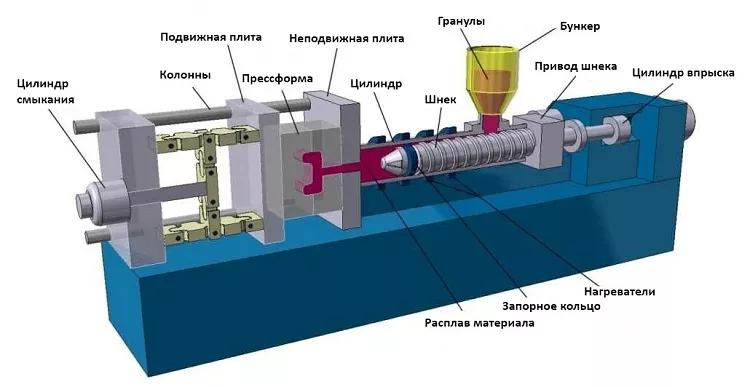
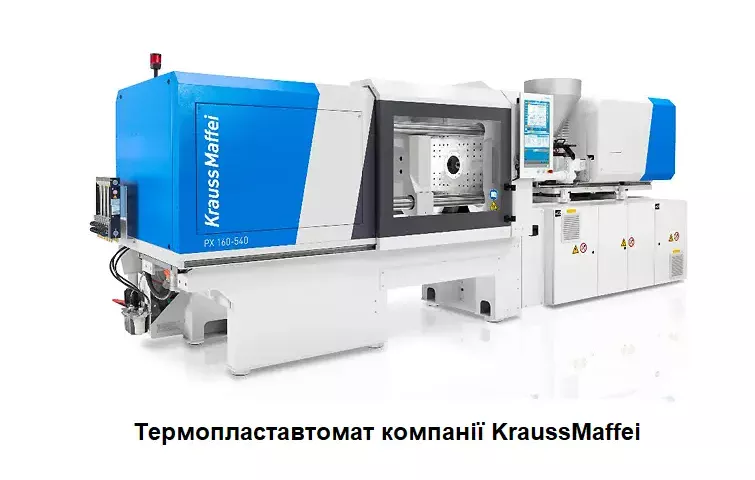
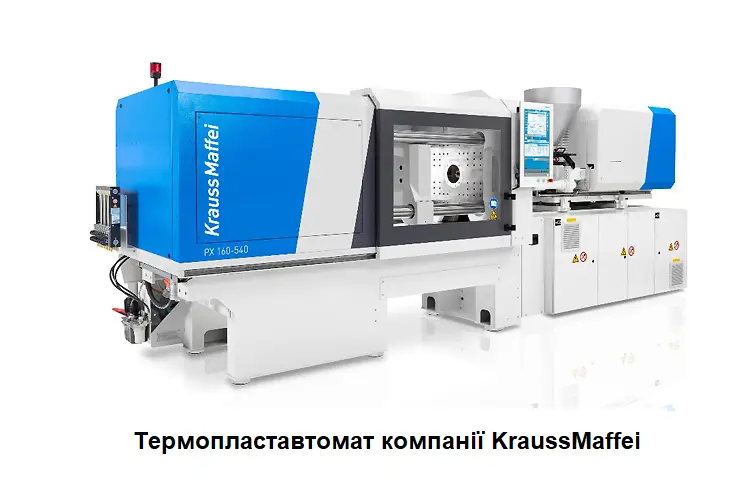
During the process, polymer pellets are fed into an injection moulding machine, where the material is heated and conveyed along the barrel by a screw. The molten thermoplastic is injected under pressure through a nozzle into a closed mould, filling its cavity. In modern machines, the material is usually conveyed by a screw, although in certain types of equipment, it may be fed by a piston.
Once the mould has been filled, the cooling process begins. When the plastic has reached sufficient rigidity, the mould is opened and the finished product is ejected. The cycle is then repeated. The mould can also be used to produce parts with metal reinforcement or other embedded components, provided this is required by the product’s design.
Plastics extrusion
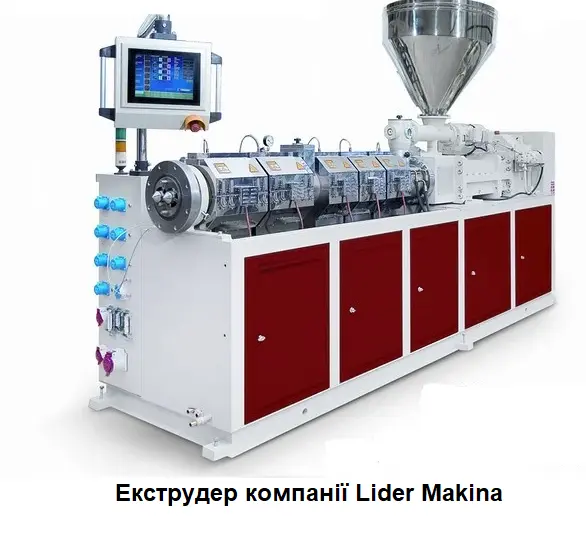
Extrusion is a continuous process for processing thermoplastics, used to manufacture profiles, pipes, hoses, sheets, films, cable sheaths and other products with a constant cross-section. Polyethylene, PVC and other thermoplastic polymers are widely used in extrusion.
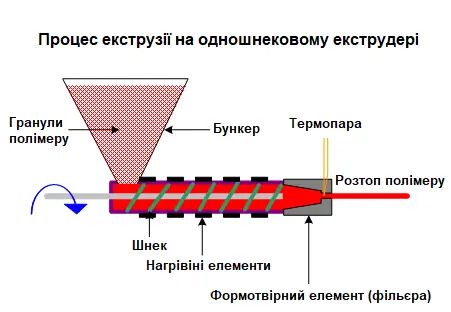
The raw material enters the extruder barrel, where it is heated and conveyed by the rotation of the screw. As it moves through the barrel, the material transitions into a plastic or molten state. The feed rate of the raw material, the temperature of the extruder zones and the screw rotation speed all influence the stability of the process and the characteristics of the finished products.
The melt is then forced through a forming head, which gives the future product the required profile. After exiting the head, the material is cooled and calibrated. During the production of sheet materials, the web may pass through rollers, which help to ensure the required thickness and geometry. The extrusion process is used to produce both simple profiles and multi-component products made from several polymers.
Thermoforming of plastics
Thermoforming is used to manufacture products from thermoplastic sheet material. The polymer sheet is first heated to a temperature at which it becomes sufficiently malleable, after which it is shaped using a mould, vacuum or pressure.
One common method is vacuum forming. A heated sheet is placed over a mould, and the air between the material and the mould surface is removed. Under the influence of the pressure difference, the plastic takes on the desired shape. Once cooled, the excess material is trimmed away.
This method is used to manufacture packaging, trays, containers, protective casings and other thin-walled plastic products. The capabilities of thermoforming depend to a large extent on the initial thickness of the sheet, the depth of the mould and the geometry of the part.
Blow Molding
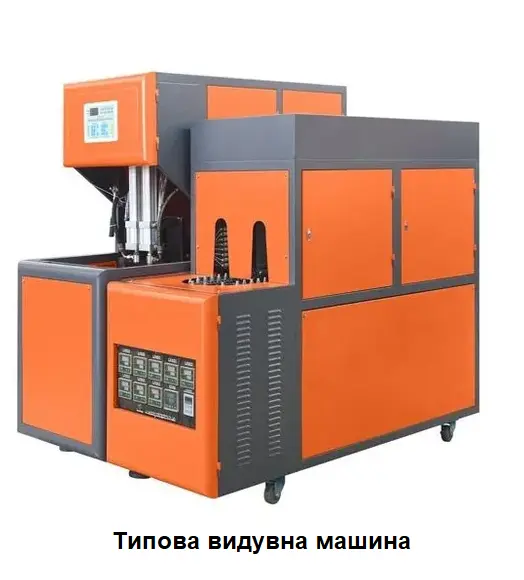
Blow moulding is mainly used for the production of hollow plastic products: bottles, canisters, vials, containers and industrial vessels. It is particularly widespread in the manufacture of packaging made from polyethylene and other thermoplastics.
During the process, the heated polymer blank is placed in a mould and pressurised air is fed into it. The material expands and is pressed against the walls of the mould, taking on its shape. Once cooled, the mould is opened and the finished product is removed.
This technology enables the production of hollow items with a relatively low mass and controlled wall thickness. The specific blow-moulding method is selected depending on the material, the shape of the packaging, its volume and the requirements for the finished product.
Rotational moulding of plastics
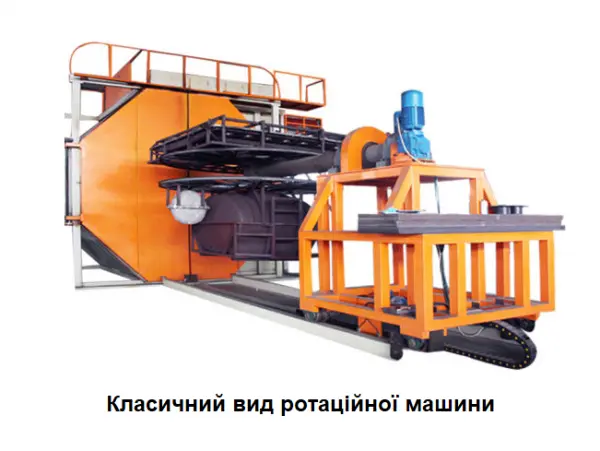
Rotational moulding is used to manufacture large hollow products, such as tanks, reservoirs, containers, housings and other components that require a one-piece construction without complex joints between separate parts.
At the start of the process, a measured quantity of polymer raw material is fed into the mould cavity. Fine-grained powders are most commonly used, in particular polyethylene-based powders. Once loaded, the mould is heated and simultaneously rotated in several planes.
As the mould rotates, the heated powder is gradually distributed across the inner surface, forming the walls of the product. The mould is then cooled, the rotation is stopped and the part is removed. Rotational moulding is suitable for large hollow products and small or medium-sized production runs, where the use of complex die-casting equipment may not be economically viable.
How to choose a manufacturing method for a plastic product
There is no one-size-fits-all method that works equally well for all plastic products. The production method must be selected to suit the specific product and its technical specifications.
When making your choice, you should bear in mind:
- Material. Polyethylene, PVC and other thermoplastic polymers have different processing temperatures and conditions, whilst products made from thermosetting materials may require moulding.
- Geometry. Injection moulding is often used for complex-shaped parts, extrusion for profiles and pipes, and blow moulding for hollow packaging.
- Dimensions and wall thickness. These factors influence the filling of the mould, the cooling of the material and the dimensional stability of the finished product.
- Production run. Mould manufacturing is primarily suitable for mass production, whilst technologies that do not require a traditional mould can be used for prototypes and one-off parts.
- Quality and cost requirements. It is necessary to assess not only the cost of the equipment, but also the cycle time, equipment productivity, polymer consumption and the unit cost of a single part within the planned production run.
The manufacturing process should be determined before production begins. A correctly selected method takes into account the properties of the plastic, the design of the part and the planned production volume, enabling the production of plastic products with consistent specifications without unnecessarily complicating the manufacturing process.